
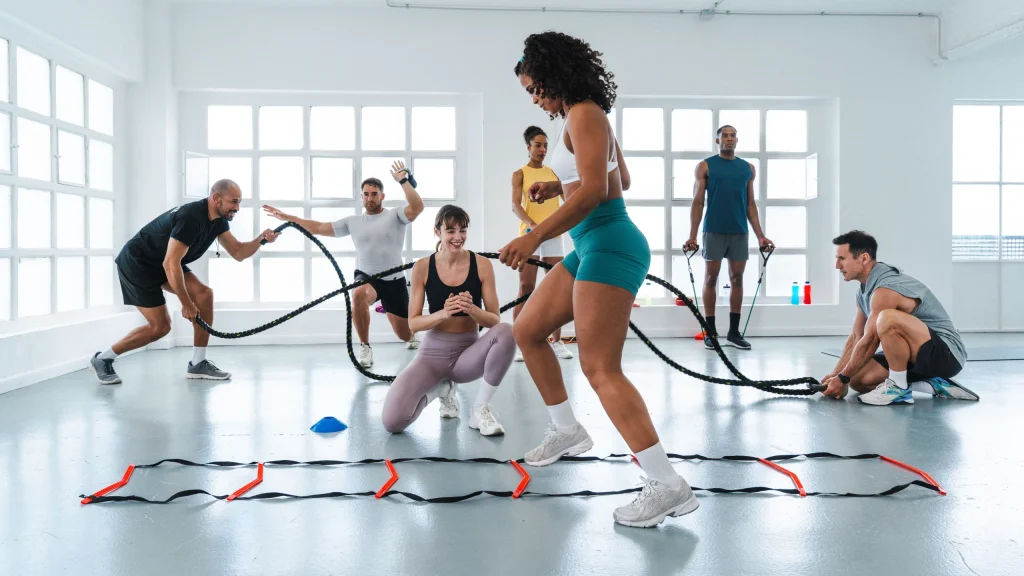
It has long been established that going to the gym can help transform your physique and improve your cardiovascular and metabolic health, but can fitness also improve cognitive function?
Aging is not just about muscle and cardiovascular decline; it’s also about the brain-body connection, and this is where neuro-fitness comes in. Neuro-fitness is defined as both physical exercise and cognitive training. Both affect the brain and body through multiple mechanisms, including neuroplasticity, improved cerebrovascular function, increased release of neurotrophic factors, and structural changes in the brain (Augusto-Oliveira et al., Molecular Neurobiology, 2023; Lo Presti et al., Human Brain Mapping, 2023). Exercise triggers the release of BDNF (brain-derived neurotrophic factor), which supports new neuron formation and synaptic health, and both aerobic and resistance exercise increase gray matter volume in the hippocampus and prefrontal cortex, the brain’s centers for memory and decision-making.
The Science of the Brain-Body Connection
But not all exercise hits the brain equally. Coordination drills are the upgrade. While standard aerobic and resistance workouts lay the foundation for brain health, it’s the complexity and challenge of coordination drills that truly set neuro-fitness apart. These exercises demand that your brain and body work in synchrony, sharpening not only memory and attention but also reaction speed and adaptability. By layering cognitive tasks onto movement, coordination drills build stronger neural pathways, making your brain more resilient against aging-related decline.
Why Coordination Drills Outperform Standard Cardio
While aerobic exercise improves cognition, it does so largely by supporting cardiovascular health, which in turn benefits the brain. Coordination training, by contrast, works directly on the brain by increasing task complexity, activating pathways for motor planning, spatial awareness, and executive control. These drills require your brain to integrate visual, vestibular, and somatosensory inputs in real time, which drives neuroplasticity in dedicated networks (Netz, Frontiers in Medicine, 2019). Most compelling, even low-intensity balance and coordination exercise has been shown to prevent age-related cognitive decline by reducing harmful hippocampal amyloid-beta deposits and neuroinflammation in animal models (Nakanishi et al., Experimental Neurology, 2021). In short, coordination drills strengthen the brain’s adaptability and resilience, making them a cornerstone of effective neuro-fitness.
Boost Brainpower with Cognitive-Motor Dual-Task Training
At the heart of neuro-fitness is cognitive-motor dual-task (CMDT) training, which involves performing a mental task, such as counting backward or naming categories, while simultaneously executing a physical drill.
This approach engages shared neural resources, creating an interaction that yields greater cognitive and physical benefits than either activity alone. A multilevel meta-analysis of 50 studies involving over 6,000 older adults found that simultaneous combined training led to the largest improvements in executive function, processing speed, and global cognition compared to single-modality training (Rieker et al., Frontiers in Human Neuroscience, 2022).
More recently, a randomized controlled trial using EEG found that CMDT training enhances the brain’s predictive capabilities in the frontal cortex, improving its ability to anticipate and prepare for movement after just five weeks (Aydin et al., Psychophysiology, 2026). The mechanism is clear: by taxing motor and cognitive networks simultaneously, these drills force the brain to allocate attention more efficiently and strengthen executive control circuits (Wollesen & Volker-Rehage, Psychology of Sport and Exercise, 2025).
For a practical example, try stepping side to side on an agility ladder while counting backward by sevens from 100. This simple combination is a powerful prescription for keeping your brain and body sharp.
Protecting Your Mobility: The Power of Proprioception
Another essential component of neuro-fitness is proprioception, your body’s internal GPS. Proprioception enables you to recognize the position and movement of your limbs without looking. Unfortunately, proprioceptive ability declines with age due to reduced mechanoreceptor sensitivity in joints, muscles, and tendons, blunting your natural response to catch yourself on uneven ground (Colón-Emeric et al., JAMA, 2024). Falls affect more than 14 million U.S. adults of the age 65+ annually and remain the leading cause of injury-related death in that age group (same source). Encouragingly, a sensorimotor exercise program has been shown to improve balance and significantly increase participants’ confidence in daily activities (Freire & Seixas, Frontiers in Physiology, 2024). Exercise interventions focused on balance and functional movements can reduce fall rates by 23% (Colón-Emeric et al., JAMA, 2024), making proprioceptive training a vital element of lifelong health.
How to Build an Anti-Aging Neuro-Fitness Routine
How can you get started? Begin with balance drills, such as single-leg stands with your eyes closed or work on a BOSU ball. Incorporate coordination drills that include a cognitive challenge, think agility ladder drills paired with counting backward, or tossing a ball while naming categories. As you progress, add unstable surfaces, change directions, or increase the cognitive demand to keep your brain and body adapting. Even brief, twice-weekly 30-minute programs produce measurable gains in balance, walking speed, and cognition (Forte et al., Aging Clinical and Experimental Research, 2023).
Neuro-fitness isn’t a trend; it’s the most efficient form of anti-aging training available because it trains the brain and body as a single system. For women who want to stay sharp and strong at every age, building neuro-fitness into your routine is a science-backed way to protect your mind, your mobility, and your independence.
Ready to put these neuro-fitness strategies into action?
Listen to the latest episode of the Love, Mia Vita podcast, where the author of this article, Kat Bright, sits down with our Founder & CEO, Gerianne DiPiano. Together, they break down exactly how you can use these brain-body strategies to stay sharp, strong, and independent at every age. Listen to the full episode here!
References:
- Augusto-Oliveira M, Arrifano GP, Leal-Nazaré CG, Santos-Sacramento L, Lopes-Araújo A, Royes LFF, Crespo-Lopez ME. Exercise Reshapes the Brain: Molecular, Cellular, and Structural Changes Associated with Cognitive Improvements. Mol Neurobiol. 2023 Dec;60(12):6950-6974. doi: 10.1007/s12035-023-03492-8. Epub 2023 Jul 31. PMID: 37518829.
- Lo Presti, S., Origlia, S., Gianelli, C., & Canessa, N. (2023). Cognition, body, and mind: A three-in-one coordinate-based fMRI meta-analysis on cognitive, physical, and meditative trainings. Human Brain Mapping, 44(9), 3795–3814. https://doi.org/10.1002/hbm.26312
- Nakanishi K, Sakakima H, Norimatsu K, Otsuka S, Takada S, Tani A, Kikuchi K. Effect of low-intensity motor balance and coordination exercise on cognitive functions, hippocampal Aβ deposition, neuronal loss, neuroinflammation, and oxidative stress in a mouse model of Alzheimer’s disease. Exp Neurol. 2021 Mar;337:113590. doi: 10.1016/j.expneurol.2020.113590. Epub 2021 Jan 1. PMID: 33388314.
- Netz Y. Is There a Preferred Mode of Exercise for Cognition Enhancement in Older Age?-A Narrative Review. Front Med (Lausanne). 2019 Mar 29;6:57. doi: 10.3389/fmed.2019.00057. PMID: 30984760; PMCID: PMC6450219.
- Rieker JA, Reales JM, Muiños M, Ballesteros S. The Effects of Combined Cognitive-Physical Interventions on Cognitive Functioning in Healthy Older Adults: A Systematic Review and Multilevel Meta-Analysis. Front Hum Neurosci. 2022 Mar 24;16:838968. doi: 10.3389/fnhum.2022.838968. PMID: 35399365; PMCID: PMC8987130.
- Wollesen B, Voelcker-Rehage C. Chronic exercise and executive functions in older adults – the treasury of combined cognitive and motor exercise. Psychol Sport Exerc. 2026 Jan;82:103023. doi: 10.1016/j.psychsport.2025.103023. Epub 2025 Nov 10. PMID: 41223908.
- Colón-Emeric CS, McDermott CL, Lee DS, Berry SD. Risk Assessment and Prevention of Falls in Older Community-Dwelling Adults: A Review. JAMA. 2024;331(16):1397–1406. doi:10.1001/jama.2024.1416
- Forte R, Trentin C, Tocci N, Lucia S, Aydin M, Di Russo F. Motor-cognitive exercise with variability of practice and feedback improves functional ability and cognition in older individuals. Aging Clin Exp Res. 2023 Nov;35(11):2797-2806. doi: 10.1007/s40520-023-02568-8. Epub 2023 Oct 19. PMID: 37853304.