
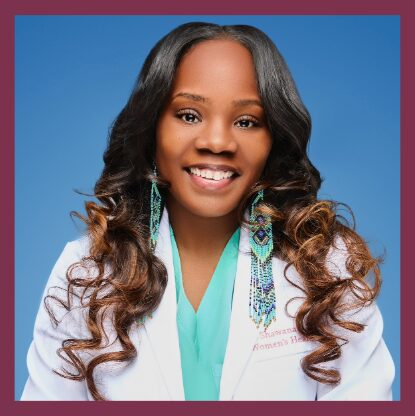
Today, we bring you the brilliant Dr. Shawana Moore, PhD, DNP to learn how Nurse Practitioners are closing the gender data gap in Women’s Health.
Dr. Moore is a board-certified Women’s Health Nurse Practitioner (WHNP) with over 15 years of experience and a member of our Medical Advisory Council. We sat down to discuss why the Nurse Practitioner (NP) is uniquely positioned to bridge the gap between medical discovery and patient care.
The interview has been condensed for clarity.
FemmePharma: Can you share a bit about your background and your passion for this space?
Dr. Moore: Absolutely! I’ve been in the healthcare space for over 15 years. Most of my work has centered around women’s health and gender-related populations, advocating for awareness around conditions that affect these populations across the lifespan. It’s a pleasure to share this knowledge with the FemmePharma community, as we share the same passion for ensuring women aren’t overlooked.
FemmePharma: We want to give Nurse Practitioners a lot of love today! Regarding the NP/MD partnership, how does the collaborative model used by NPs enhance the quality and accessibility of health services, particularly in areas where physicians are limited?
Dr. Moore: This is a vital question. Nurse practitioners rank among the top professionals in America—at one point recently, it was the number one profession. Collaboration is part of our makeup; we are taught early on to work with physicians, social workers, and therapists. We don’t work in a silo.
In states like Georgia, where I live, OBGYN access is incredibly limited. Nurse practitioners are key to closing these gaps. We allow for timely access to care, and the data shows we typically have more time to spend with the patient. Because we don’t always have a surgical schedule or the same in-hospital demands, we can provide a holistic approach that includes the patient’s family and community.
FemmePharma: Why is a Nurse Practitioner with a specialized concentration in women’s health or menopause more likely to be proactively screening for conditions like GSM than a general primary care provider?
Dr. Moore: It’s about the didactic training. WHNPs go through coursework and clinical practice focused specifically on these populations. While our physician colleagues are trained in this as well, their path involves medical school, then residency, then fellowship. NPs are already registered nurses; we then move into a post-licensure master’s or doctoral program, which is often faster-paced and puts us into specialized practice sooner.
Furthermore, organizations like The Menopause Society offer special certifications for licensed providers. Because of our educational timeline, we get this specialized training early and are placed into the clinical setting where these symptoms fall directly under our scope of care.
FemmePharma: You mentioned something critical: “level of comfort.” Why is it that even if the education is present, some providers still struggle to address women’s health issues?
Dr. Moore: Every healthcare provider—MD or NP—meets the academic standards. But what happens after graduation? What continuing education are you pursuing? What professional organizations are you engaging to become more confident and knowledgeable about the topic area? Historically, menopause was overlooked and shrouded in misinformation, which made the healthcare community afraid to appropriately manage or treat it. Now, barriers are being broken. More science and evidence are being presented. It is the provider’s responsibility to seek that knowledge and professional alignment to become confident. If you’ve never prescribed a medication or referred to a specific practice because you lack confidence in that data, you won’t do it. We have to push our own comfort zones to give patients the care they deserve.
FemmePharma: At FemmePharma, we talk a lot about the “gender data gap.” How is the shift in research—studying women—changing the way you practice?
Dr. Moore: It’s a breakthrough. Years ago, women weren’t the focus of research. Now that women are part of the studies, we can understand the processes occurring within the female body and develop better treatment modalities. My hope is that we ensure women get the best possible treatment throughout their lifespan, regardless of their health conditions. And, that healthcare and science can meet women exactly where they are.
FemmePharma: How do you approach the “menu” of treatment options, especially when balancing pharmacological and non-pharmacological interventions?
Dr. Moore: I always tell my patients: you are the most important member of this healthcare team. I present the “menu”—the appetizers, the main course, and the dessert. I look at their medical history and their desires. If a patient has a genetic mutation that increases blood-clot risk, I explain why a certain hormonal method isn’t for them.
We have to tailor the plan. Some women aren’t comfortable with a vaginal cream, and that’s okay. We find a different option. These conversations take time; they aren’t five-minute visits. It’s about ensuring the patient’s voice is at the forefront of the table.
FemmePharma: You’re describing listening—real, open listening—to the patient’s story. Is this the standard we should hold all providers to?
Dr. Moore: Absolutely. It takes a team to care for a patient correctly. We are dedicated to lifelong learning. We must go beyond our learning in school to bring the most current evidence into the space to ensure we are doing the very best we can as providers.
FemmePharma: If you could leave us with one final thought, what would it be?
Dr. Moore: The most important three things are: Listen, Validate, and Act. We must listen to our patients because they are the compass of their bodies. We must validate what they are experiencing. And finally, we must act. Without action, their exposure of their symptoms goes to no avail. If you aren’t comfortable managing a condition, phone a colleague or find a referral source. We have a pivotal role in ensuring every woman experiences every life cycle in the most enjoyable, comfortable manner possible.
Dr. Shawana Moore, PhD, DNP, APRN, WHNP-BC, PNAP, FAAN is a Women’s Health Nurse Practitioner and Associate Professor at Emory University DNP Program Director of Nursing. She is also a member of the FemmePharma Medical Advisory Council.