
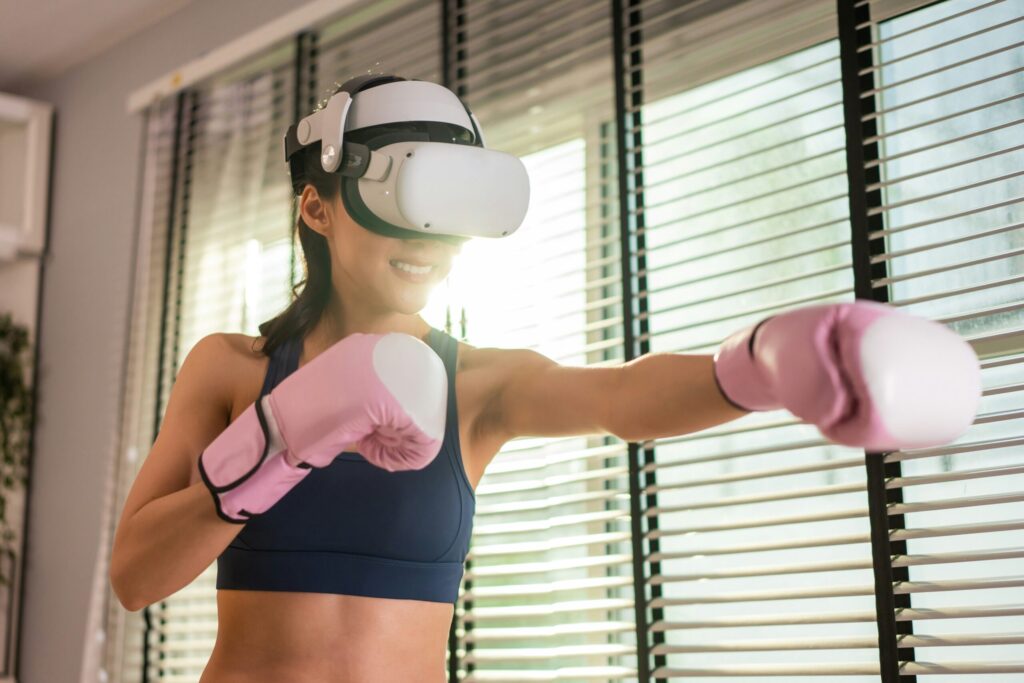
In today’s technology-driven fitness landscape, the potential of virtual reality (VR) and augmented reality (AR) workouts to transform the way we exercise is inspiring. With conventional exercise programs struggling to overcome dropout rates as high as 50% within 3-6 months due to a lack of motivation, limited access, and low engagement (Barbour et al., 2024). The critical question arises: Can VR and AR workouts deliver the same physiological benefits as traditional exercise while addressing these adherence barriers? The research reveals that while VR and AR workouts can achieve comparable physiological outcomes to conventional exercise, their most significant advantage lies in dramatically higher enjoyment. Plus engagement rates, which may be the key to solving fitness’s long-term adherence challenge.
Physiological Effectiveness: VR Delivers Real Results
Multiple studies have demonstrated that VR and AR workouts can produce significant physiological benefits comparable to those of traditional exercise. Mologne et al. (2022) conducted a comprehensive 12-week randomized controlled trial comparing immersive VR exergaming with traditional self-directed exercise. The results were striking: participants using the VR system achieved superior improvements across multiple fitness metrics. Including greater increases in upper and lower body muscular strength (14.3 kg vs. 10.0 kg improvement in upper body 1-RM), better muscular endurance gains, superior peak leg power improvements (1424 vs. 865 W). Plus more significant body fat reduction (-3.7% vs. -1.9%), and better cardiovascular improvements in VO2max (3.28 vs. 0.89 mL/min/kg improvement). Remarkably, the VR group accomplished these superior results while spending 14 fewer minutes per session, demonstrating the efficiency potential of well-designed virtual workout programs and the promising future of fitness.
Supporting this evidence, Barbour et al. (2024) found that participants engaging in immersive VR boxing workouts chose to exercise at higher intensities (%VO2max) compared to the same workout presented on a traditional 2D screen. The immersive nature of VR naturally encourages participants to push themselves harder physically, potentially leading to greater fitness adaptations. The study controlled for visual and auditory stimuli, isolating the impact of immersion itself on exercise intensity and outcomes.
Psychological Superiority: The Engagement Advantage
Where VR and AR workouts truly stand out are with psychological benefits and user engagement. Mocco et al. (2024) conducted a systematic review of 20 studies examining immersive VR-enhanced physical activity. They found consistent evidence that VR exercise was associated with increased enjoyment, reduced perceived exertion. As well as higher rates of self-efficacy, intrinsic motivation, and exercise intention compared to traditional exercise. This psychological advantage addresses the primary reasons people abandon exercise programs: boredom, discomfort, and lack of motivation. The potential of VR and AR workouts to address these issues and keep users engaged is intriguing.
The immediate psychological benefits are equally impressive. Barbour et al. (2024) demonstrated that when participants completed identical workouts in VR versus on a 2D screen. The VR condition produced significantly higher levels of enjoyment across all measured subscales. As well as higher positive affect and lower negative affect following exercise. These findings suggest that VR’s immersive environment fundamentally alters the psychological experience of exercise, making it more pleasant and sustainable. Participants also reported lower ratings of perceived exertion during VR workouts despite exercising at higher intensities. Indicating that the engaging virtual environment serves as an effective distraction from exercise discomfort.
Virtual vs. In-Person Training: Bridging the Gap
The comparison between virtual and in-person training reveals nuanced advantages for different delivery methods. Oginni et al. (2024) directly compared traditional in-person exercise programs led by on-site trainers with virtual exercise classes conducted via video conferencing (Zoom) among corporate employees. The results demonstrated that virtual-based exercise programs delivered statistically equivalent health improvements in blood pressure reduction. In addition to, body mass index decreases, and waist circumference improvements compared to traditional in-person training. This finding is particularly significant because it demonstrates that even basic video-based virtual training, which does not require expensive VR equipment, can match the physiological benefits of in-person instruction. It offers greater scheduling flexibility and eliminating transportation barriers.
Building on this foundation, immersive VR and AR technologies offer additional advantages over both traditional in-person training and basic video conferencing. While video-based virtual training achieves physiological equivalence to in-person instruction, fully immersive VR environments provide the enhanced engagement and motivation benefits that neither traditional in-person nor video-based training can match. The research suggests a hierarchy of virtual training effectiveness. Where basic video conferencing yields results comparable to in-person training, and immersive technologies potentially surpass them in both physiological and psychological outcomes.
The consistency of findings across different populations and exercise modalities strengthens the evidence base. Whether examining resistance training with cable systems (Mologne et al., 2022), aerobic boxing workouts (Barbour et al., 2024), or mixed exercise programs in corporate settings (Oginni et al., 2024), the research consistently shows that well-designed VR and AR interventions can match or exceed traditional exercise outcomes while providing superior psychological benefits.
Conclusion
The scientific evidence provides a clear answer: VR and AR workouts do work. And in many cases, work better than both traditional in-person and basic virtual exercise approaches. The research reveals a spectrum of virtual training effectiveness, ranging from video-based conferencing that matches in-person physiological results to immersive VR environments that surpass traditional training in both physical outcomes and psychological engagement. While all virtual modalities deliver comparable physiological benefits to in-person training, immersive VR and AR technologies offer the additional advantage of superior enjoyment. Along with motivation, and engagement, addressing exercise’s most significant challenge: long-term adherence. Rather than replacing in-person training entirely, these technologies offer compelling alternatives that can match or exceed traditional outcomes. While providing greater accessibility, convenience, and sustainability for diverse populations seeking effective physical activity solutions.
References
- Barbour, B., Sefton, L., Bruce, R. M., Valmaggia, L., & Runswick, O. R. (2024). Acute psychological and physiological benefits of exercising with virtual reality. PLoS One, 19(12), e0314331. https://doi.org/10.1371/journal.pone.0314331
- Mocco, A., Valmaggia, L., Bernardi, L., Alfieri, M., & Tarricone, I. (2024). Enhancing physical activity with immersive virtual reality: A systematic review. Cyberpsychology, Behavior and Social Networking, 27(5), 303-317. https://doi.org/10.1089/cyber.2023.0394
- Mologne, M. S., Hu, J., Carrillo, E., Shelton, J., McKeon, K., Vyas, N., … & Signorile, J. F. (2022). The efficacy of an immersive virtual reality exergame incorporating an adaptive cable resistance system on fitness and cardiometabolic measures: A 12-week randomized controlled trial. International Journal of Environmental Research and Public Health, 20(1), 210. https://doi.org/10.3390/ijerph20010210
- Oginni, J., Otinwa, G., & Gao, Z. (2024). The Physical Impact of Traditional and Virtual Physical Exercise Programs on Health Outcomes Among Corporate Employees. Journal of Clinical Medicine, 13(3), 694. https://doi.org/10.3390/jcm13030694